| Availability: | |
|---|---|
| Quantity: | |
In the intricate world of electronics manufacturing and repair, the reliability of every connection hinges on the quality of the solder used. Among the myriad of options available, the Tin Solder Roll 63 37 stands as a time-tested and trusted standard. Specifically, the Tin Solder Roll Sn63Pb37 alloy, with its precise eutectic composition of 63% tin and 37% lead, offers unparalleled performance for circuit board assembly. This comprehensive guide delves into every aspect of this essential material, exploring its properties, the advantages of various package weights like the Tin Solder Roll 63 37 100g and Tin Solder Roll 63 37 1kg, and the critical role of specifications such as the Tin Solder Roll 63 37 0.8mm diameter. Whether you are a professional engineer, a technician, or a hobbyist, understanding the nuances of this solder can significantly elevate the quality and reliability of your electronic projects.
The designation Tin Solder Roll 63 37 refers to a specific alloy where tin (Sn) constitutes 63% of the blend and lead (Pb) makes up the remaining 37%. This ratio is not arbitrary; it is the eutectic point for the tin-lead system. A eutectic alloy has the lowest possible melting point of any mixture of its constituent metals. For Sn63Pb37, this melting point is approximately 183°C (361°F). The primary advantage of a eutectic composition is that it transitions directly from a solid to a liquid state at a single temperature, without passing through a plastic or "pasty" range. This characteristic is crucial in electronics assembly, as it allows for rapid solidification, minimizing the risk of disturbed joints and ensuring sharp, reliable connections.
The Tin Solder Roll Sn63Pb37 is renowned for several key properties:
Excellent Wettability: It flows smoothly and efficiently over copper pads and component leads, creating strong intermetallic bonds.
Superior Solder Joint Strength: The resulting joints are mechanically robust and resistant to fatigue.
Reliable Electrical Conductivity: It ensures low-resistance electrical paths.
Established Reliability: Decades of use across industries from consumer electronics to aerospace have proven its long-term performance.
While lead-free alternatives have gained prominence due to environmental regulations (like RoHS), the Tin Solder Roll 63 37 remains the preferred choice for many high-reliability, military, aerospace, and certain repair applications where its proven performance is critical.
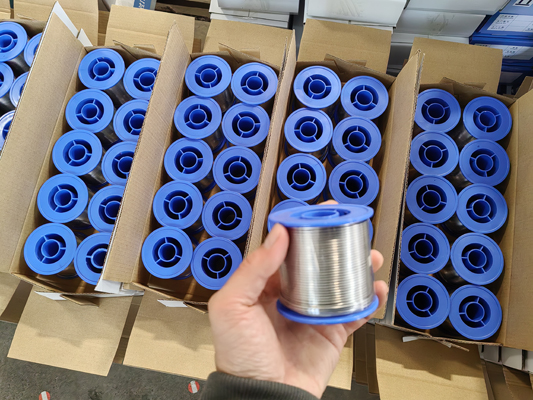
The diameter of the solder wire is a critical, yet often overlooked, specification. The Tin Solder Roll 63 37 0.8mm represents a highly versatile and popular size for a wide range of PCB assembly tasks. This 0.8mm diameter offers an ideal balance between control and deposition rate. It is thin enough to allow for precise application in soldering intricate components, such as fine-pitch ICs, surface-mount devices (SMDs like 0805, 0603, or even smaller), and densely packed boards, without causing bridging or excess solder. Simultaneously, it is substantial enough to efficiently solder through-hole components and larger connections without requiring an excessive amount of wire to be fed.
Using the correct diameter, like the 0.8mm variant, directly impacts workflow efficiency and joint quality. A wire that is too thick for delicate work can lead to messy joints and thermal damage to small components. Conversely, a wire that is too thin for larger joints will slow down production and may not deliver enough solder for a reliable connection. The Tin Solder Roll 63 37 0.8mm serves as an excellent general-purpose choice, making it a staple in both manual soldering stations and automated dispensers for rework and prototyping.
Selecting the appropriate package size for your Tin Solder Roll is essential for cost-effectiveness, convenience, and material freshness. Solder wire can oxidize over time, especially if the flux core is exposed to air. Therefore, matching the package size to your usage rate helps maintain optimal performance. Here’s a detailed breakdown of common weights available for the Tin Solder Roll Sn63Pb37.
The Tin Solder Roll 63 37 100g package is perfectly tailored for electronics hobbyists, students, and technicians who engage in periodic repair work or small-scale prototyping. It is compact, affordable, and provides a sufficient amount of solder for numerous projects without the worry of the material degrading from long-term storage. This size is easy to handle and store, making it a popular entry-point package.
Stepping up in volume, the Tin Solder Roll 63 37 200g and Tin Solder Roll 63 37 250g rolls cater to more frequent users. These sizes are ideal for professional technicians, small to medium repair shops, and R&D departments where soldering is a regular but not continuous daily activity. They offer a better cost-per-gram value than the 100g roll and reduce the frequency of reordering, thereby improving operational efficiency while still being a manageable size.
For busy workshops, manufacturing floors involved in low to medium-volume production runs, and dedicated makerspaces, the Tin Solder Roll 63 37 500g is a workhorse. It strikes an excellent balance between bulk economy and practicality. This size significantly lowers the cost per joint and is well-suited for environments where multiple technicians share materials or where a single production line consumes solder consistently.
The Tin Solder Roll 63 37 1kg roll is designed for maximum economy in high-volume manufacturing environments, large-scale repair facilities, or for procurement managers stocking central inventory. This package offers the lowest cost per gram and minimizes packaging waste and frequency of roll changes on automated systems. Proper storage in a controlled environment is recommended when using this large size to preserve the flux activity and prevent oxidation over its extended usage period.
A standard Tin Solder Roll is not just a solid metal wire; it is engineered as a flux-cored wire. The flux is a chemically active material housed in the center of the solder wire. As the solder melts, the flux is released to perform several vital functions simultaneously:
Cleaning: It removes oxides and contaminants from the metal surfaces to be joined (component leads and PCB pads).
Protecting: It forms a protective barrier during heating to prevent re-oxidation.
Promoting Wetting: It reduces the surface tension of the molten solder, allowing it to flow smoothly and adhere strongly to the clean metals.
The performance of a Tin Solder Roll Sn63Pb37 is heavily influenced by the type and quality of its flux core. Common flux types include:
Rosin (R) and Rosin Mildly Activated (RMA): These are traditional, reliable fluxes that are generally non-corrosive and leave a residue that may or may not require cleaning, depending on the specific grade and application requirements.
No-Clean Flux: This is the most common type found in modern solder wires. It is designed to leave a benign, non-conductive, and non-corrosive residue that does not need to be removed after soldering, streamlining the production process.
Water-Soluble Flux: These aggressive fluxes offer excellent cleaning power but leave a corrosive residue that must be thoroughly cleaned with water after soldering.
When selecting your Tin Solder Roll 63 37, ensure the flux type (e.g., No-Clean, RMA) is suitable for your assembly process and post-solder cleaning capabilities.

To achieve perfect solder joints consistently with your Tin Solder Roll, follow these best practices:
Cleanliness is Key: Ensure the PCB and component leads are clean and free of oils or heavy oxidation before starting.
Proper Temperature: Set your soldering iron tip to an appropriate temperature, typically between 300°C and 350°C (572°F - 662°F) for Sn63Pb37. The tip must be clean and well-tinned.
The Correct Method: Apply the tip to the junction of the pad and lead to heat both elements simultaneously. Then, feed the Tin Solder Roll 63 37 0.8mm wire into the opposite side of the junction—not directly onto the iron tip. The solder should melt and flow smoothly around the joint due to capillary action.
Inspect the Joint: A good solder joint for through-hole components should be shiny, concave, and fill the pad completely. For surface-mount work, the solder should form a smooth fillet against the component and pad.
Prolong the life and effectiveness of your solder:
Store Tin Solder Roll in a cool, dry place, ideally in its original sealed packaging or a resealable container.
Minimize exposure to air to prevent flux degradation and solder oxidation.
Handle the wire with clean hands or gloves to avoid contaminating the flux core.
The Tin Solder Roll Sn63Pb37 is incredibly versatile in PCB assembly:
Through-Hole Technology (THT): Excellent for soldering resistors, capacitors, connectors, and other leaded components.
Surface-Mount Technology (SMT) Rework and Repair: The 0.8mm diameter is ideal for manually reworking chip components, QFPs, and BGAs (with proper skill and tools).
Point-to-Point Wiring and Prototyping: Indispensable for creating custom circuits on prototyping boards or for making modifications.
Automated Soldering: Suitable for use in certain automated soldering equipment where wire feed is required.
From the meticulous work of a hobbyist with a Tin Solder Roll 63 37 100g to the high-speed demands of a factory using a Tin Solder Roll 63 37 1kg, the Sn63Pb37 alloy remains a cornerstone of electronic interconnection. Its eutectic properties, combined with the practical versatility of the Tin Solder Roll 63 37 0.8mm diameter, provide a reliable solution for creating strong, conductive, and durable solder joints. By understanding the different package weights—from 100g to 1kg—and selecting the appropriate one for your needs, you can optimize both cost and performance. Whether navigating complex SMT layouts or assembling robust through-hole boards, a high-quality Tin Solder Roll is more than just a consumable; it is a fundamental tool for bringing electronic designs to life with confidence and reliability.
Contact us:
Email: xfsolder@163.com or xfsolder@gmail.com
WhatsApp/Wechat: 008613450770997
In the intricate world of electronics manufacturing and repair, the reliability of every connection hinges on the quality of the solder used. Among the myriad of options available, the Tin Solder Roll 63 37 stands as a time-tested and trusted standard. Specifically, the Tin Solder Roll Sn63Pb37 alloy, with its precise eutectic composition of 63% tin and 37% lead, offers unparalleled performance for circuit board assembly. This comprehensive guide delves into every aspect of this essential material, exploring its properties, the advantages of various package weights like the Tin Solder Roll 63 37 100g and Tin Solder Roll 63 37 1kg, and the critical role of specifications such as the Tin Solder Roll 63 37 0.8mm diameter. Whether you are a professional engineer, a technician, or a hobbyist, understanding the nuances of this solder can significantly elevate the quality and reliability of your electronic projects.
The designation Tin Solder Roll 63 37 refers to a specific alloy where tin (Sn) constitutes 63% of the blend and lead (Pb) makes up the remaining 37%. This ratio is not arbitrary; it is the eutectic point for the tin-lead system. A eutectic alloy has the lowest possible melting point of any mixture of its constituent metals. For Sn63Pb37, this melting point is approximately 183°C (361°F). The primary advantage of a eutectic composition is that it transitions directly from a solid to a liquid state at a single temperature, without passing through a plastic or "pasty" range. This characteristic is crucial in electronics assembly, as it allows for rapid solidification, minimizing the risk of disturbed joints and ensuring sharp, reliable connections.
The Tin Solder Roll Sn63Pb37 is renowned for several key properties:
Excellent Wettability: It flows smoothly and efficiently over copper pads and component leads, creating strong intermetallic bonds.
Superior Solder Joint Strength: The resulting joints are mechanically robust and resistant to fatigue.
Reliable Electrical Conductivity: It ensures low-resistance electrical paths.
Established Reliability: Decades of use across industries from consumer electronics to aerospace have proven its long-term performance.
While lead-free alternatives have gained prominence due to environmental regulations (like RoHS), the Tin Solder Roll 63 37 remains the preferred choice for many high-reliability, military, aerospace, and certain repair applications where its proven performance is critical.

The diameter of the solder wire is a critical, yet often overlooked, specification. The Tin Solder Roll 63 37 0.8mm represents a highly versatile and popular size for a wide range of PCB assembly tasks. This 0.8mm diameter offers an ideal balance between control and deposition rate. It is thin enough to allow for precise application in soldering intricate components, such as fine-pitch ICs, surface-mount devices (SMDs like 0805, 0603, or even smaller), and densely packed boards, without causing bridging or excess solder. Simultaneously, it is substantial enough to efficiently solder through-hole components and larger connections without requiring an excessive amount of wire to be fed.
Using the correct diameter, like the 0.8mm variant, directly impacts workflow efficiency and joint quality. A wire that is too thick for delicate work can lead to messy joints and thermal damage to small components. Conversely, a wire that is too thin for larger joints will slow down production and may not deliver enough solder for a reliable connection. The Tin Solder Roll 63 37 0.8mm serves as an excellent general-purpose choice, making it a staple in both manual soldering stations and automated dispensers for rework and prototyping.
Selecting the appropriate package size for your Tin Solder Roll is essential for cost-effectiveness, convenience, and material freshness. Solder wire can oxidize over time, especially if the flux core is exposed to air. Therefore, matching the package size to your usage rate helps maintain optimal performance. Here’s a detailed breakdown of common weights available for the Tin Solder Roll Sn63Pb37.
The Tin Solder Roll 63 37 100g package is perfectly tailored for electronics hobbyists, students, and technicians who engage in periodic repair work or small-scale prototyping. It is compact, affordable, and provides a sufficient amount of solder for numerous projects without the worry of the material degrading from long-term storage. This size is easy to handle and store, making it a popular entry-point package.
Stepping up in volume, the Tin Solder Roll 63 37 200g and Tin Solder Roll 63 37 250g rolls cater to more frequent users. These sizes are ideal for professional technicians, small to medium repair shops, and R&D departments where soldering is a regular but not continuous daily activity. They offer a better cost-per-gram value than the 100g roll and reduce the frequency of reordering, thereby improving operational efficiency while still being a manageable size.
For busy workshops, manufacturing floors involved in low to medium-volume production runs, and dedicated makerspaces, the Tin Solder Roll 63 37 500g is a workhorse. It strikes an excellent balance between bulk economy and practicality. This size significantly lowers the cost per joint and is well-suited for environments where multiple technicians share materials or where a single production line consumes solder consistently.
The Tin Solder Roll 63 37 1kg roll is designed for maximum economy in high-volume manufacturing environments, large-scale repair facilities, or for procurement managers stocking central inventory. This package offers the lowest cost per gram and minimizes packaging waste and frequency of roll changes on automated systems. Proper storage in a controlled environment is recommended when using this large size to preserve the flux activity and prevent oxidation over its extended usage period.
A standard Tin Solder Roll is not just a solid metal wire; it is engineered as a flux-cored wire. The flux is a chemically active material housed in the center of the solder wire. As the solder melts, the flux is released to perform several vital functions simultaneously:
Cleaning: It removes oxides and contaminants from the metal surfaces to be joined (component leads and PCB pads).
Protecting: It forms a protective barrier during heating to prevent re-oxidation.
Promoting Wetting: It reduces the surface tension of the molten solder, allowing it to flow smoothly and adhere strongly to the clean metals.
The performance of a Tin Solder Roll Sn63Pb37 is heavily influenced by the type and quality of its flux core. Common flux types include:
Rosin (R) and Rosin Mildly Activated (RMA): These are traditional, reliable fluxes that are generally non-corrosive and leave a residue that may or may not require cleaning, depending on the specific grade and application requirements.
No-Clean Flux: This is the most common type found in modern solder wires. It is designed to leave a benign, non-conductive, and non-corrosive residue that does not need to be removed after soldering, streamlining the production process.
Water-Soluble Flux: These aggressive fluxes offer excellent cleaning power but leave a corrosive residue that must be thoroughly cleaned with water after soldering.
When selecting your Tin Solder Roll 63 37, ensure the flux type (e.g., No-Clean, RMA) is suitable for your assembly process and post-solder cleaning capabilities.

To achieve perfect solder joints consistently with your Tin Solder Roll, follow these best practices:
Cleanliness is Key: Ensure the PCB and component leads are clean and free of oils or heavy oxidation before starting.
Proper Temperature: Set your soldering iron tip to an appropriate temperature, typically between 300°C and 350°C (572°F - 662°F) for Sn63Pb37. The tip must be clean and well-tinned.
The Correct Method: Apply the tip to the junction of the pad and lead to heat both elements simultaneously. Then, feed the Tin Solder Roll 63 37 0.8mm wire into the opposite side of the junction—not directly onto the iron tip. The solder should melt and flow smoothly around the joint due to capillary action.
Inspect the Joint: A good solder joint for through-hole components should be shiny, concave, and fill the pad completely. For surface-mount work, the solder should form a smooth fillet against the component and pad.
Prolong the life and effectiveness of your solder:
Store Tin Solder Roll in a cool, dry place, ideally in its original sealed packaging or a resealable container.
Minimize exposure to air to prevent flux degradation and solder oxidation.
Handle the wire with clean hands or gloves to avoid contaminating the flux core.
The Tin Solder Roll Sn63Pb37 is incredibly versatile in PCB assembly:
Through-Hole Technology (THT): Excellent for soldering resistors, capacitors, connectors, and other leaded components.
Surface-Mount Technology (SMT) Rework and Repair: The 0.8mm diameter is ideal for manually reworking chip components, QFPs, and BGAs (with proper skill and tools).
Point-to-Point Wiring and Prototyping: Indispensable for creating custom circuits on prototyping boards or for making modifications.
Automated Soldering: Suitable for use in certain automated soldering equipment where wire feed is required.
From the meticulous work of a hobbyist with a Tin Solder Roll 63 37 100g to the high-speed demands of a factory using a Tin Solder Roll 63 37 1kg, the Sn63Pb37 alloy remains a cornerstone of electronic interconnection. Its eutectic properties, combined with the practical versatility of the Tin Solder Roll 63 37 0.8mm diameter, provide a reliable solution for creating strong, conductive, and durable solder joints. By understanding the different package weights—from 100g to 1kg—and selecting the appropriate one for your needs, you can optimize both cost and performance. Whether navigating complex SMT layouts or assembling robust through-hole boards, a high-quality Tin Solder Roll is more than just a consumable; it is a fundamental tool for bringing electronic designs to life with confidence and reliability.
Contact us:
Email: xfsolder@163.com or xfsolder@gmail.com
WhatsApp/Wechat: 008613450770997
The selection of solder is a foundational element in the successful assembly and repair of LED lighting systems. The eutectic 63 37 sn pb solder offers an unparalleled combination of a low melting point, excellent wettability, and joint reliability that is perfectly suited to the thermal sensitivity of LED components. By understanding the specific applications for each diameter—from the precision of 63 37 sn pb solder 1.0mm to the power of 63 37 sn pb solder 2.0mm—you can dramatically improve the quality and efficiency of your work. Packaging this superior alloy as solder in a reel, specifically in a 63 37 sn pb solder 1 kg reel, adds layers of practicality, economy, and consistency that benefit everyone from the professional production engineer to the meticulous hobbyist. Therefore, equipping your workspace with the appropriate diameter of 63 37 sn pb solder for LED Lights is not just a purchase; it is an investment in achieving superior, reliable, and professional results in all you
Our comprehensive range of 63 37 leaded wire solder for electronics is meticulously designed to meet the exacting demands of modern electronics work. The eutectic 63/37 tin-lead alloy guarantees reliable, shiny joints free from cold solder defects. The availability of both 63 37 leaded solder 0.6mm for precision tasks and 63 37 leaded solder 0.9mm for versatile general-purpose work ensures you have the right tool for every job. Furthermore, our flexible packaging—from the bulk 63 37 leaded solder 454g for professionals, to the standard 63 37 leaded solder 227g, and the accessible 63 37 leaded solder 100g for beginners—means there is a perfect option for every user and budget. Elevate your soldering work with the proven performance and quality of genuine 63 37 leaded solder.
Welcome to XF Solder, a leading manufacturer from China dedicated to producing high-quality soldering materials for the global market. We specialize in creating reliable, consistent, and performance-driven solder products that meet the rigorous demands of various industries. Our flagship product, the 60 40 Solder .032'' 1 lb spool, represents the gold standard in through-hole and general-purpose electronics assembly. This article provides a detailed overview of why this specific formulation and packaging is an indispensable inventory item for distributors, a superior choice for importers seeking quality from China, and a perfect 60 40 Solder 1 lb for Wholesale operations globally. We will explore its technical specifications, unparalleled benefits, and the strategic advantage it offers in the competitive electronics supply chain.
The combination of the proven 60 sn 40 pb alloy, the convenience of three standard diameters (1.6mm, 1.8mm, 2mm), and the economic 1lb (454g) packaging makes this product an indispensable tool for anyone involved in creating or repairing electrical assemblies. Whether you are a seasoned engineer working on complex industrial systems or a hobbyist bringing your first circuit to life, this 60 40 sn pb wire solder provides the performance, reliability, and value you need to ensure every connection is perfect. Stock up on this classic soldering solution today and experience the difference that quality materials make.