| Availability: | |
|---|---|
| Quantity: | |
In the intricate world of electronics manufacturing and precision repair, the choice of solder is not merely a detail—it is a foundational decision that dictates the quality, reliability, and longevity of an electrical connection. Amidst a sea of specialized alloys and fluxes, one formulation has stood the test of time, offering a remarkable balance of strength, usability, and electrical integrity. This guide delves deep into the world of 50 50 rosin core solder, a premium material re-engineered for the modern era. We will explore the unique advantages of our specific product line: Hydraulic 50 50 Rosin Core Solder Wire, available in practical 450g and 500g solder wire rolls, and precision-engineered in 1.6mm, 3mm, and 3.2mm diameters. This is not just another solder; it is a sophisticated tool designed for professionals who refuse to compromise on performance.
To appreciate the advanced nature of our hydraulic solder wire, one must first grasp the core principles of its composition. The term "50 50 solder wire" refers to an alloy consisting of 50% tin and 50% lead. This eutectic or near-eutectic formulation has been a cornerstone of electronics for decades, and for good reason. It possesses a well-defined melting point, which is crucial for creating smooth, shiny, and reliable solder joints. Unlike other alloys that have a plastic or "pasty" range, high-quality 50 50 rosin core solder transitions rapidly from solid to liquid and back, minimizing the risk of cold joints and other defects caused by movement during solidification.
The "rosin core" component is equally critical. Inside the tubular solder wire, a flux core of purified rosin is housed. This flux serves a dual purpose during the soldering process. Primarily, it acts as a cleaning agent, removing oxides and other contaminants from the metal surfaces to be joined. Secondly, it coats the molten solder, preventing re-oxidation in the presence of air until the joint has properly solidified. The result is a clean, metallurgically sound bond with excellent electrical conductivity and mechanical strength. Our formulation uses a meticulously refined rosin that is sufficiently active for most applications yet leaves minimal, non-corrosive residue.
The 50/50 tin-lead ratio strikes an optimal balance between several key physical properties. The tin content provides the necessary wetting action, allowing the solder to flow evenly and adhere to component leads and PCB pads. The lead content contributes to the alloy's overall strength and ductility, reducing the susceptibility to thermal and mechanical fatigue. While lead-free alternatives have their place, the 50 50 rosin core solder wire remains the preferred choice for many mission-critical, high-reliability, and repair applications where its proven track record and superior workability are paramount.
The term "hydraulic solder wire" represents a significant advancement in solder manufacturing technology. Traditional solder wire is extruded using mechanical force, which can sometimes lead to inconsistencies in the flux core's placement and density. Our hydraulic process, however, utilizes controlled fluid pressure to form the solder wire. This state-of-the-art method ensures an absolutely concentric and continuous flux core that runs perfectly through the center of the wire along its entire length.
Why does this matter? A concentric flux core is the hallmark of a premium solder. It guarantees that the flux is delivered uniformly to the solder joint, regardless of the angle at which the wire is applied. This eliminates the common frustration of "flux starvation" in certain sections of the wire, which can lead to poor wetting and weak joints. With our hydraulic solder wire, every inch of the product delivers a consistent, predictable, and high-performance soldering experience. This manufacturing excellence translates directly to fewer defects, higher throughput on production lines, and more reliable repairs in the field.
The hydraulic method offers tangible benefits that distinguish it from conventional solder:
Unparalleled Flux Core Consistency: The core is uniform in density and placement, ensuring reliable flux delivery for every joint.
Superior Surface Finish: The wire has a smooth, clean surface with minimal oxidation, promoting better feeding and reducing the risk of clogging or sputtering.
Enhanced Process Control: The precision of hydraulic formation allows for tighter tolerances on diameter, making the 50 50 rosin core solder 1.6mm, 3mm, and 3.2mm variants exceptionally precise.

Selecting the correct solder diameter is as important as choosing the right alloy. Using a diameter that is too large for fine-pitch work can lead to bridging and shorts, while a diameter that is too small for a large connection will slow down the process and may result in an insufficiently filled joint. Our Hydraulic 50 50 Rosin Core Solder Wire is offered in three industry-standard diameters to cater to a vast spectrum of applications.
The 50 50 rosin core solder 1.6mm variant is the go-to solution for detailed, precision work. Its slender profile makes it ideal for:
Surface-mount technology (SMT) components, such as fine-pitch ICs (Integrated Circuits), 0603 and 0402 resistors/capacitors.
Densely packed printed circuit boards (PCBs) found in smartphones, laptops, and other consumer electronics.
Intricate rework and repair tasks under a microscope.
Jewelry making and other small-scale metallurgical arts.
The fine gauge allows for excellent control over the amount of solder deposited, minimizing the need for solder wick and rework.
The 50 50 rosin core solder 3mm diameter represents the perfect balance between control and deposition rate. It is an exceptionally versatile size suitable for a wide array of general-purpose tasks, including:
Through-hole component soldering (resistors, capacitors, connectors).
Automotive wiring repairs and harness building.
General electrical work on outlets and switches.
Appliance repair and maintenance.
Stained glass assembly.
For many technicians and engineers, the 3mm diameter is the default choice for its ability to handle both moderately fine work and larger connections with ease.
When the application involves high-speed production or joining large gauge wires and metal sheets, the 50 50 rosin core solder 3.2mm is the optimal tool. Its larger diameter delivers a greater volume of solder per unit length, which significantly increases the speed of operation in high-volume manufacturing environments. Key applications include:
Automated soldering systems in factory assembly lines.
Soldering heavy-duty connectors, lugs, and terminals.
Radiator repair and other plumbing-related tasks (with appropriate safety measures).
Sheet metal work and artistic sculptures.
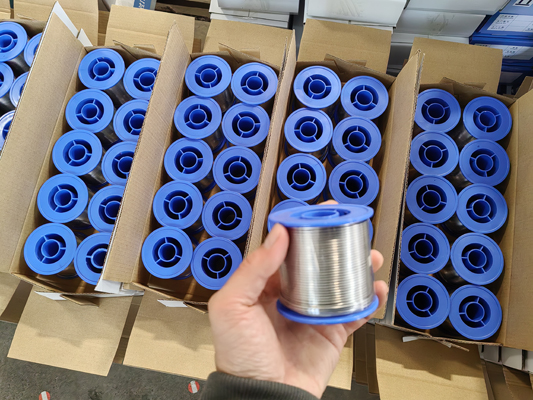
We understand that professionals require packaging that is both practical and protective. Our solder is supplied in robust, hermetically sealed rolls to prevent oxidation and maintain the product's freshness from our factory to your workbench. We offer two weight options to suit different usage patterns: the 50 50 rosin core solder wire 450g and the 50 50 rosin core solder 500g.
The 500g solder wire roll is the industry-standard bulk size, ideal for production facilities, busy repair shops, and dedicated hobbyists who demand a long-lasting supply. It offers excellent value and reduces the frequency of reordering. The slightly smaller 450g roll provides a convenient option for those with varying project needs or for trying a new diameter without a major commitment. Both sizes are wound on a sturdy plastic spool with a secure catch for the wire's end, preventing tangles and ensuring neat, organized storage.
Opting for the 50 50 rosin core solder 500g package is a decision for efficiency and economy. For high-volume users, it minimizes material cost per joint and reduces downtime associated with changing spools. The consistency guaranteed by our hydraulic process means that from the first inch to the last on a 500g solder wire roll, the performance remains identical, ensuring uniform quality across an entire production run or a large project.
The specific combination of the 50/50 alloy and our advanced hydraulic manufacturing makes this product line exceptionally versatile. Its use extends across numerous industries and disciplines.
Electronics Manufacturing and Assembly: From consumer gadgets to industrial control systems, this solder ensures reliable, high-conductivity connections on PCBs.
Rework and Repair: Technicians repairing vintage audio equipment, classic computer hardware, or other lead-compatible electronics rely on genuine 50 50 rosin core solder for its authentic and reliable performance.
Automotive and Aviation Electronics: The robust joints formed by this solder are resistant to vibration and thermal cycling, making it suitable for demanding environments in vehicles and aircraft (where regulations permit).
Electrical Engineering and Prototyping: Engineers and students use it for building and testing prototypes on breadboards and perfboards due to its excellent wetting and easy workability.
Art and Craftsmanship: Stained glass artists, jewelry makers, and model builders value the smooth flow and strong bond it provides for their creative and structural joins.
To achieve the best results with our product, adhering to proper soldering techniques is essential.
Surface Preparation: Always ensure that the surfaces to be soldered are clean and free of dirt, grease, and heavy oxidation. The flux is designed to handle light oxides, but pre-cleaning is always beneficial.
Tool Selection: Use a temperature-controlled soldering iron with a tip that is appropriate for the task. A chisel tip is excellent for through-hole components, while a fine conical tip is better for SMD work.
Temperature Setting: For 50 50 rosin core solder, a tip temperature between 315°C and 370°C (600°F - 700°F) is typically ideal. Excessive heat can damage components and break down the flux too quickly, while insufficient heat will cause poor wetting.
The Soldering Technique: Apply the tip to both the component lead and the PCB pad to heat them simultaneously. Then, feed the 50 50 solder wire into the junction, not directly onto the iron tip. The molten solder should flow smoothly and evenly to form a concave, shiny fillet—the signature of a good joint.
Post-Soldering Care: While the rosin residue is generally non-corrosive, it can be sticky and attract dust. For critical applications or aesthetic reasons, it can be removed with a specialized rosin flux remover.
In a market flooded with generic and often substandard products, our Hydraulic 50 50 Rosin Core Solder Wire stands apart. It is a synthesis of a time-tested, high-performance alloy and a cutting-edge, precision manufacturing process. Whether you require the finesse of the 50 50 rosin core solder 1.6mm for micro-soldering, the versatility of the 3mm, the high-volume efficiency of the 50 50 rosin core solder 3.2mm, or the economic advantage of the 50 50 rosin core solder 500g roll, this product line is engineered to exceed expectations. By choosing this hydraulic solder wire, you are not just buying a consumable; you are investing in reliability, efficiency, and the unwavering quality that defines professional-grade workmanship. Elevate your soldering process today with the consistent, concentric performance that only true hydraulic formation can provide.
Contact us:
Email: xfsolder@163.com xfsolder@gmail.com
WhatsApp/Wechat: 008613450770997
In the intricate world of electronics manufacturing and precision repair, the choice of solder is not merely a detail—it is a foundational decision that dictates the quality, reliability, and longevity of an electrical connection. Amidst a sea of specialized alloys and fluxes, one formulation has stood the test of time, offering a remarkable balance of strength, usability, and electrical integrity. This guide delves deep into the world of 50 50 rosin core solder, a premium material re-engineered for the modern era. We will explore the unique advantages of our specific product line: Hydraulic 50 50 Rosin Core Solder Wire, available in practical 450g and 500g solder wire rolls, and precision-engineered in 1.6mm, 3mm, and 3.2mm diameters. This is not just another solder; it is a sophisticated tool designed for professionals who refuse to compromise on performance.
To appreciate the advanced nature of our hydraulic solder wire, one must first grasp the core principles of its composition. The term "50 50 solder wire" refers to an alloy consisting of 50% tin and 50% lead. This eutectic or near-eutectic formulation has been a cornerstone of electronics for decades, and for good reason. It possesses a well-defined melting point, which is crucial for creating smooth, shiny, and reliable solder joints. Unlike other alloys that have a plastic or "pasty" range, high-quality 50 50 rosin core solder transitions rapidly from solid to liquid and back, minimizing the risk of cold joints and other defects caused by movement during solidification.
The "rosin core" component is equally critical. Inside the tubular solder wire, a flux core of purified rosin is housed. This flux serves a dual purpose during the soldering process. Primarily, it acts as a cleaning agent, removing oxides and other contaminants from the metal surfaces to be joined. Secondly, it coats the molten solder, preventing re-oxidation in the presence of air until the joint has properly solidified. The result is a clean, metallurgically sound bond with excellent electrical conductivity and mechanical strength. Our formulation uses a meticulously refined rosin that is sufficiently active for most applications yet leaves minimal, non-corrosive residue.
The 50/50 tin-lead ratio strikes an optimal balance between several key physical properties. The tin content provides the necessary wetting action, allowing the solder to flow evenly and adhere to component leads and PCB pads. The lead content contributes to the alloy's overall strength and ductility, reducing the susceptibility to thermal and mechanical fatigue. While lead-free alternatives have their place, the 50 50 rosin core solder wire remains the preferred choice for many mission-critical, high-reliability, and repair applications where its proven track record and superior workability are paramount.
The term "hydraulic solder wire" represents a significant advancement in solder manufacturing technology. Traditional solder wire is extruded using mechanical force, which can sometimes lead to inconsistencies in the flux core's placement and density. Our hydraulic process, however, utilizes controlled fluid pressure to form the solder wire. This state-of-the-art method ensures an absolutely concentric and continuous flux core that runs perfectly through the center of the wire along its entire length.
Why does this matter? A concentric flux core is the hallmark of a premium solder. It guarantees that the flux is delivered uniformly to the solder joint, regardless of the angle at which the wire is applied. This eliminates the common frustration of "flux starvation" in certain sections of the wire, which can lead to poor wetting and weak joints. With our hydraulic solder wire, every inch of the product delivers a consistent, predictable, and high-performance soldering experience. This manufacturing excellence translates directly to fewer defects, higher throughput on production lines, and more reliable repairs in the field.
The hydraulic method offers tangible benefits that distinguish it from conventional solder:
Unparalleled Flux Core Consistency: The core is uniform in density and placement, ensuring reliable flux delivery for every joint.
Superior Surface Finish: The wire has a smooth, clean surface with minimal oxidation, promoting better feeding and reducing the risk of clogging or sputtering.
Enhanced Process Control: The precision of hydraulic formation allows for tighter tolerances on diameter, making the 50 50 rosin core solder 1.6mm, 3mm, and 3.2mm variants exceptionally precise.

Selecting the correct solder diameter is as important as choosing the right alloy. Using a diameter that is too large for fine-pitch work can lead to bridging and shorts, while a diameter that is too small for a large connection will slow down the process and may result in an insufficiently filled joint. Our Hydraulic 50 50 Rosin Core Solder Wire is offered in three industry-standard diameters to cater to a vast spectrum of applications.
The 50 50 rosin core solder 1.6mm variant is the go-to solution for detailed, precision work. Its slender profile makes it ideal for:
Surface-mount technology (SMT) components, such as fine-pitch ICs (Integrated Circuits), 0603 and 0402 resistors/capacitors.
Densely packed printed circuit boards (PCBs) found in smartphones, laptops, and other consumer electronics.
Intricate rework and repair tasks under a microscope.
Jewelry making and other small-scale metallurgical arts.
The fine gauge allows for excellent control over the amount of solder deposited, minimizing the need for solder wick and rework.
The 50 50 rosin core solder 3mm diameter represents the perfect balance between control and deposition rate. It is an exceptionally versatile size suitable for a wide array of general-purpose tasks, including:
Through-hole component soldering (resistors, capacitors, connectors).
Automotive wiring repairs and harness building.
General electrical work on outlets and switches.
Appliance repair and maintenance.
Stained glass assembly.
For many technicians and engineers, the 3mm diameter is the default choice for its ability to handle both moderately fine work and larger connections with ease.
When the application involves high-speed production or joining large gauge wires and metal sheets, the 50 50 rosin core solder 3.2mm is the optimal tool. Its larger diameter delivers a greater volume of solder per unit length, which significantly increases the speed of operation in high-volume manufacturing environments. Key applications include:
Automated soldering systems in factory assembly lines.
Soldering heavy-duty connectors, lugs, and terminals.
Radiator repair and other plumbing-related tasks (with appropriate safety measures).
Sheet metal work and artistic sculptures.

We understand that professionals require packaging that is both practical and protective. Our solder is supplied in robust, hermetically sealed rolls to prevent oxidation and maintain the product's freshness from our factory to your workbench. We offer two weight options to suit different usage patterns: the 50 50 rosin core solder wire 450g and the 50 50 rosin core solder 500g.
The 500g solder wire roll is the industry-standard bulk size, ideal for production facilities, busy repair shops, and dedicated hobbyists who demand a long-lasting supply. It offers excellent value and reduces the frequency of reordering. The slightly smaller 450g roll provides a convenient option for those with varying project needs or for trying a new diameter without a major commitment. Both sizes are wound on a sturdy plastic spool with a secure catch for the wire's end, preventing tangles and ensuring neat, organized storage.
Opting for the 50 50 rosin core solder 500g package is a decision for efficiency and economy. For high-volume users, it minimizes material cost per joint and reduces downtime associated with changing spools. The consistency guaranteed by our hydraulic process means that from the first inch to the last on a 500g solder wire roll, the performance remains identical, ensuring uniform quality across an entire production run or a large project.
The specific combination of the 50/50 alloy and our advanced hydraulic manufacturing makes this product line exceptionally versatile. Its use extends across numerous industries and disciplines.
Electronics Manufacturing and Assembly: From consumer gadgets to industrial control systems, this solder ensures reliable, high-conductivity connections on PCBs.
Rework and Repair: Technicians repairing vintage audio equipment, classic computer hardware, or other lead-compatible electronics rely on genuine 50 50 rosin core solder for its authentic and reliable performance.
Automotive and Aviation Electronics: The robust joints formed by this solder are resistant to vibration and thermal cycling, making it suitable for demanding environments in vehicles and aircraft (where regulations permit).
Electrical Engineering and Prototyping: Engineers and students use it for building and testing prototypes on breadboards and perfboards due to its excellent wetting and easy workability.
Art and Craftsmanship: Stained glass artists, jewelry makers, and model builders value the smooth flow and strong bond it provides for their creative and structural joins.
To achieve the best results with our product, adhering to proper soldering techniques is essential.
Surface Preparation: Always ensure that the surfaces to be soldered are clean and free of dirt, grease, and heavy oxidation. The flux is designed to handle light oxides, but pre-cleaning is always beneficial.
Tool Selection: Use a temperature-controlled soldering iron with a tip that is appropriate for the task. A chisel tip is excellent for through-hole components, while a fine conical tip is better for SMD work.
Temperature Setting: For 50 50 rosin core solder, a tip temperature between 315°C and 370°C (600°F - 700°F) is typically ideal. Excessive heat can damage components and break down the flux too quickly, while insufficient heat will cause poor wetting.
The Soldering Technique: Apply the tip to both the component lead and the PCB pad to heat them simultaneously. Then, feed the 50 50 solder wire into the junction, not directly onto the iron tip. The molten solder should flow smoothly and evenly to form a concave, shiny fillet—the signature of a good joint.
Post-Soldering Care: While the rosin residue is generally non-corrosive, it can be sticky and attract dust. For critical applications or aesthetic reasons, it can be removed with a specialized rosin flux remover.
In a market flooded with generic and often substandard products, our Hydraulic 50 50 Rosin Core Solder Wire stands apart. It is a synthesis of a time-tested, high-performance alloy and a cutting-edge, precision manufacturing process. Whether you require the finesse of the 50 50 rosin core solder 1.6mm for micro-soldering, the versatility of the 3mm, the high-volume efficiency of the 50 50 rosin core solder 3.2mm, or the economic advantage of the 50 50 rosin core solder 500g roll, this product line is engineered to exceed expectations. By choosing this hydraulic solder wire, you are not just buying a consumable; you are investing in reliability, efficiency, and the unwavering quality that defines professional-grade workmanship. Elevate your soldering process today with the consistent, concentric performance that only true hydraulic formation can provide.
Contact us:
Email: xfsolder@163.com xfsolder@gmail.com
WhatsApp/Wechat: 008613450770997
The selection of solder is a foundational element in the successful assembly and repair of LED lighting systems. The eutectic 63 37 sn pb solder offers an unparalleled combination of a low melting point, excellent wettability, and joint reliability that is perfectly suited to the thermal sensitivity of LED components. By understanding the specific applications for each diameter—from the precision of 63 37 sn pb solder 1.0mm to the power of 63 37 sn pb solder 2.0mm—you can dramatically improve the quality and efficiency of your work. Packaging this superior alloy as solder in a reel, specifically in a 63 37 sn pb solder 1 kg reel, adds layers of practicality, economy, and consistency that benefit everyone from the professional production engineer to the meticulous hobbyist. Therefore, equipping your workspace with the appropriate diameter of 63 37 sn pb solder for LED Lights is not just a purchase; it is an investment in achieving superior, reliable, and professional results in all you
Our comprehensive range of 63 37 leaded wire solder for electronics is meticulously designed to meet the exacting demands of modern electronics work. The eutectic 63/37 tin-lead alloy guarantees reliable, shiny joints free from cold solder defects. The availability of both 63 37 leaded solder 0.6mm for precision tasks and 63 37 leaded solder 0.9mm for versatile general-purpose work ensures you have the right tool for every job. Furthermore, our flexible packaging—from the bulk 63 37 leaded solder 454g for professionals, to the standard 63 37 leaded solder 227g, and the accessible 63 37 leaded solder 100g for beginners—means there is a perfect option for every user and budget. Elevate your soldering work with the proven performance and quality of genuine 63 37 leaded solder.
Welcome to XF Solder, a leading manufacturer from China dedicated to producing high-quality soldering materials for the global market. We specialize in creating reliable, consistent, and performance-driven solder products that meet the rigorous demands of various industries. Our flagship product, the 60 40 Solder .032'' 1 lb spool, represents the gold standard in through-hole and general-purpose electronics assembly. This article provides a detailed overview of why this specific formulation and packaging is an indispensable inventory item for distributors, a superior choice for importers seeking quality from China, and a perfect 60 40 Solder 1 lb for Wholesale operations globally. We will explore its technical specifications, unparalleled benefits, and the strategic advantage it offers in the competitive electronics supply chain.
The combination of the proven 60 sn 40 pb alloy, the convenience of three standard diameters (1.6mm, 1.8mm, 2mm), and the economic 1lb (454g) packaging makes this product an indispensable tool for anyone involved in creating or repairing electrical assemblies. Whether you are a seasoned engineer working on complex industrial systems or a hobbyist bringing your first circuit to life, this 60 40 sn pb wire solder provides the performance, reliability, and value you need to ensure every connection is perfect. Stock up on this classic soldering solution today and experience the difference that quality materials make.