| Availability: | |
|---|---|
| Quantity: | |
In the alchemist’s workshop of modern electronics, where connections are conjured and circuits are given life, lies a fundamental tome of metallic fusion—the Coil of Solder Wire. This is not merely a spool of alloy; it is a continuous, poised scroll of potential. Among its kind, one formulation stands as a paragon of eutectic perfection: the Tin Lead 63/37. This specific ratio, a harmonious marriage of 63% tin to 37% lead, represents more than a material specification; it is a legacy of reliability, a benchmark for seamless coalescence in the realm of electrical and mechanical union. To hold a solder coil of this caliber is to grasp the very thread that weaves the tapestry of contemporary technology, from the simplest switch to the most sophisticated silicon brain.
What sorcery lies within a coil of solder wire 63/37? The answer resides in a principle known as the eutectic point. Unlike other alloys that solidify over a range of temperatures, the 63/37 blend performs a singular, magical transition. It moves from a liquid state to a solid state at one precise temperature—183°C (361°F). This eutectic characteristic is the core of its legendary performance. When applied, the solder from your solder coil 63/37 does not enter a pasty, semi-solid phase. It solidifies almost instantaneously upon cooling, minimizing the risk of cold joints, fractures, and defects. This creates a connection that is not just electrically sound but mechanically robust, a critical factor in assemblies subjected to vibration or thermal stress.
Conceptually, the coil of solder wire Tin Lead 63/37 is the perfect synthesis of two distinct metallic personalities. Imagine, if you will, a coil of tin wire: malleable, resistant to corrosion, and possessing a bright, silvery sheen. Tin is the facilitator, the element that readily wets to copper and other base metals, allowing the solder to flow and adhere. Its counterpart, the conceptual coil of lead wire, contributes its own vital properties: lowering the alloy’s melting point significantly, improving ductility, and enhancing the final joint's resistance to fatigue. In the 63/37 amalgam, lead tempers the brittleness of pure tin, resulting in a joint that can absorb slight mechanical shocks. Together, within the confines of a single coil of solder, they create a whole far greater than the sum of their parts, a testament to metallurgical synergy.
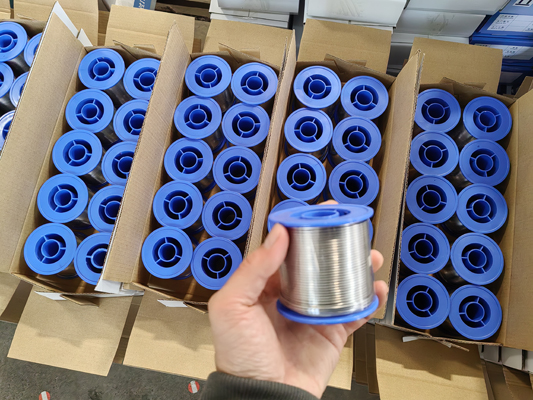
The configuration of the material as a solder wire coil is a masterpiece of practical design. This compact, spiraled form factor offers a multitude of advantages that transcend mere storage. It allows for smooth, tangle-free dispensing, enabling the craftsperson to draw exactly the required length with a simple pull, minimizing waste. The coil’s structure promotes natural rigidity while feeding into automated soldering systems, ensuring consistent delivery without snags. For the manual artisan, a coil of solder rests comfortably on the workbench, rotating freely to provide access from any angle, making it an ergonomic companion during hours of intricate work. It is the unsung hero of workflow efficiency.
Within the universe of the Coil of Solder Wire, the 63/37 alloy is just the beginning. This metallic ribbon is often infused with a rosin or acid flux core. This internal channel of chemical activator is pivotal; it cleans the metal surfaces during soldering, removing oxides and ensuring a pristine, metallurgically pure bond. The diameter of the wire, or its gauge, within the solder wire coil is equally crucial. Finer gauges (e.g., 0.5mm) are the tools of precision for surface-mount devices and delicate circuitry, while thicker wires (e.g., 1.0mm or more) deliver higher volumetric flow for larger connectors or grounding lugs. Thus, a single coil of solder 63/37 can be tailored to a vast array of applications through its flux type and physical dimensions.
The coil of solder wire 63/37 finds its sacred place in numerous arenas. For the electronics repair technician, it is the go-to material for its predictable behavior and strong, shiny joints. In the prototyping lab, where reliability cannot be compromised, this eutectic alloy is trusted to bring schematic dreams into physical reality. Its use extends beyond circuit boards to stained glass artistry, plumbing (for non-potable water lines), and sheet metal work, where its lower melting point and excellent capillary action are prized. Wherever a durable, conductive, and relatively low-temperature metallic bond is required, this specific solder coil stands ready.
Scaling from the workbench to the factory floor, the demand transforms. Here, the narrative shifts to solder wire 63 37 for wholesale. Manufacturing lines consuming solder at a voracious pace require a dependable, uninterrupted supply. Purchasing coil of solder wire in wholesale quantities—often in larger, industrial-sized spools or multiple-kilo packages—ensures consistency across production batches, reduces material cost per unit, and minimizes operational downtime. For distributors and large-scale assembly houses, sourcing a solder coil 63/37 for wholesale is not a simple purchase; it is a strategic supply chain decision that directly impacts product quality and bottom-line efficiency.

It is imperative to acknowledge the context surrounding the coil of lead wire component. Global regulations, most notably the EU's Restriction of Hazardous Substances (RoHS), have restricted the use of lead in most consumer electronics due to its environmental and health impact. This has propelled the advancement of excellent lead-free alternatives. However, the coil of solder wire Tin Lead 63/37 retains its sanctioned and critical role in exempted sectors: aerospace, military, automotive electronics, and certain medical equipment, where absolute joint reliability under extreme conditions is non-negotiable. In these fields, its performance legacy outweighs regulatory restrictions. Safe handling—with adequate ventilation, hygiene, and fume extraction—remains paramount when working with any solder, especially those containing lead.
Choosing the right coil of solder 63/37 is an exercise in discernment. Look for suppliers who provide certified mill certificates or compliance reports, ensuring the alloy's composition is precise. The shine and consistency of the wire’s surface can indicate good quality control. The flux core should be evenly centered and appropriately active for your intended materials (rosin core for electronics, acid core for plumbing). Whether you seek a single solder wire coil for a hobby project or are investigating solder wire 63 37 for wholesale for an enterprise, partnering with a reputable supplier guarantees that the fundamental thread of your construction is of the highest caliber.
The Coil of Solder Wire, particularly in the timeless Tin Lead 63/37 formulation, is far more than an industrial commodity. It is a physical manifestation of a fundamental principle: connection. Its coiled form symbolizes continuity, readiness, and potential energy awaiting release. The solder coil is the bridge across gaps, the remedy for discontinuity, the creator of paths for electrons to flow. In a world racing towards the next digital frontier, this humble, spiraled scroll remains an indispensable artifact in the maker’s toolkit. From the artisan repairing a cherished radio to the automated arm populating a mission-critical circuit board, the coil of solder wire 63/37 continues to fuse the past with the present, one perfect, eutectic joint at a time. Its story, like its form, is an unbroken circle of reliability, precision, and essential utility.
Contact us:
Email: xfsolder@163.com or xfsolder@gmail.com
WhatsApp/Wechat: 008613450770997
In the alchemist’s workshop of modern electronics, where connections are conjured and circuits are given life, lies a fundamental tome of metallic fusion—the Coil of Solder Wire. This is not merely a spool of alloy; it is a continuous, poised scroll of potential. Among its kind, one formulation stands as a paragon of eutectic perfection: the Tin Lead 63/37. This specific ratio, a harmonious marriage of 63% tin to 37% lead, represents more than a material specification; it is a legacy of reliability, a benchmark for seamless coalescence in the realm of electrical and mechanical union. To hold a solder coil of this caliber is to grasp the very thread that weaves the tapestry of contemporary technology, from the simplest switch to the most sophisticated silicon brain.
What sorcery lies within a coil of solder wire 63/37? The answer resides in a principle known as the eutectic point. Unlike other alloys that solidify over a range of temperatures, the 63/37 blend performs a singular, magical transition. It moves from a liquid state to a solid state at one precise temperature—183°C (361°F). This eutectic characteristic is the core of its legendary performance. When applied, the solder from your solder coil 63/37 does not enter a pasty, semi-solid phase. It solidifies almost instantaneously upon cooling, minimizing the risk of cold joints, fractures, and defects. This creates a connection that is not just electrically sound but mechanically robust, a critical factor in assemblies subjected to vibration or thermal stress.
Conceptually, the coil of solder wire Tin Lead 63/37 is the perfect synthesis of two distinct metallic personalities. Imagine, if you will, a coil of tin wire: malleable, resistant to corrosion, and possessing a bright, silvery sheen. Tin is the facilitator, the element that readily wets to copper and other base metals, allowing the solder to flow and adhere. Its counterpart, the conceptual coil of lead wire, contributes its own vital properties: lowering the alloy’s melting point significantly, improving ductility, and enhancing the final joint's resistance to fatigue. In the 63/37 amalgam, lead tempers the brittleness of pure tin, resulting in a joint that can absorb slight mechanical shocks. Together, within the confines of a single coil of solder, they create a whole far greater than the sum of their parts, a testament to metallurgical synergy.

The configuration of the material as a solder wire coil is a masterpiece of practical design. This compact, spiraled form factor offers a multitude of advantages that transcend mere storage. It allows for smooth, tangle-free dispensing, enabling the craftsperson to draw exactly the required length with a simple pull, minimizing waste. The coil’s structure promotes natural rigidity while feeding into automated soldering systems, ensuring consistent delivery without snags. For the manual artisan, a coil of solder rests comfortably on the workbench, rotating freely to provide access from any angle, making it an ergonomic companion during hours of intricate work. It is the unsung hero of workflow efficiency.
Within the universe of the Coil of Solder Wire, the 63/37 alloy is just the beginning. This metallic ribbon is often infused with a rosin or acid flux core. This internal channel of chemical activator is pivotal; it cleans the metal surfaces during soldering, removing oxides and ensuring a pristine, metallurgically pure bond. The diameter of the wire, or its gauge, within the solder wire coil is equally crucial. Finer gauges (e.g., 0.5mm) are the tools of precision for surface-mount devices and delicate circuitry, while thicker wires (e.g., 1.0mm or more) deliver higher volumetric flow for larger connectors or grounding lugs. Thus, a single coil of solder 63/37 can be tailored to a vast array of applications through its flux type and physical dimensions.
The coil of solder wire 63/37 finds its sacred place in numerous arenas. For the electronics repair technician, it is the go-to material for its predictable behavior and strong, shiny joints. In the prototyping lab, where reliability cannot be compromised, this eutectic alloy is trusted to bring schematic dreams into physical reality. Its use extends beyond circuit boards to stained glass artistry, plumbing (for non-potable water lines), and sheet metal work, where its lower melting point and excellent capillary action are prized. Wherever a durable, conductive, and relatively low-temperature metallic bond is required, this specific solder coil stands ready.
Scaling from the workbench to the factory floor, the demand transforms. Here, the narrative shifts to solder wire 63 37 for wholesale. Manufacturing lines consuming solder at a voracious pace require a dependable, uninterrupted supply. Purchasing coil of solder wire in wholesale quantities—often in larger, industrial-sized spools or multiple-kilo packages—ensures consistency across production batches, reduces material cost per unit, and minimizes operational downtime. For distributors and large-scale assembly houses, sourcing a solder coil 63/37 for wholesale is not a simple purchase; it is a strategic supply chain decision that directly impacts product quality and bottom-line efficiency.

It is imperative to acknowledge the context surrounding the coil of lead wire component. Global regulations, most notably the EU's Restriction of Hazardous Substances (RoHS), have restricted the use of lead in most consumer electronics due to its environmental and health impact. This has propelled the advancement of excellent lead-free alternatives. However, the coil of solder wire Tin Lead 63/37 retains its sanctioned and critical role in exempted sectors: aerospace, military, automotive electronics, and certain medical equipment, where absolute joint reliability under extreme conditions is non-negotiable. In these fields, its performance legacy outweighs regulatory restrictions. Safe handling—with adequate ventilation, hygiene, and fume extraction—remains paramount when working with any solder, especially those containing lead.
Choosing the right coil of solder 63/37 is an exercise in discernment. Look for suppliers who provide certified mill certificates or compliance reports, ensuring the alloy's composition is precise. The shine and consistency of the wire’s surface can indicate good quality control. The flux core should be evenly centered and appropriately active for your intended materials (rosin core for electronics, acid core for plumbing). Whether you seek a single solder wire coil for a hobby project or are investigating solder wire 63 37 for wholesale for an enterprise, partnering with a reputable supplier guarantees that the fundamental thread of your construction is of the highest caliber.
The Coil of Solder Wire, particularly in the timeless Tin Lead 63/37 formulation, is far more than an industrial commodity. It is a physical manifestation of a fundamental principle: connection. Its coiled form symbolizes continuity, readiness, and potential energy awaiting release. The solder coil is the bridge across gaps, the remedy for discontinuity, the creator of paths for electrons to flow. In a world racing towards the next digital frontier, this humble, spiraled scroll remains an indispensable artifact in the maker’s toolkit. From the artisan repairing a cherished radio to the automated arm populating a mission-critical circuit board, the coil of solder wire 63/37 continues to fuse the past with the present, one perfect, eutectic joint at a time. Its story, like its form, is an unbroken circle of reliability, precision, and essential utility.
Contact us:
Email: xfsolder@163.com or xfsolder@gmail.com
WhatsApp/Wechat: 008613450770997
The selection of solder is a foundational element in the successful assembly and repair of LED lighting systems. The eutectic 63 37 sn pb solder offers an unparalleled combination of a low melting point, excellent wettability, and joint reliability that is perfectly suited to the thermal sensitivity of LED components. By understanding the specific applications for each diameter—from the precision of 63 37 sn pb solder 1.0mm to the power of 63 37 sn pb solder 2.0mm—you can dramatically improve the quality and efficiency of your work. Packaging this superior alloy as solder in a reel, specifically in a 63 37 sn pb solder 1 kg reel, adds layers of practicality, economy, and consistency that benefit everyone from the professional production engineer to the meticulous hobbyist. Therefore, equipping your workspace with the appropriate diameter of 63 37 sn pb solder for LED Lights is not just a purchase; it is an investment in achieving superior, reliable, and professional results in all you
Our comprehensive range of 63 37 leaded wire solder for electronics is meticulously designed to meet the exacting demands of modern electronics work. The eutectic 63/37 tin-lead alloy guarantees reliable, shiny joints free from cold solder defects. The availability of both 63 37 leaded solder 0.6mm for precision tasks and 63 37 leaded solder 0.9mm for versatile general-purpose work ensures you have the right tool for every job. Furthermore, our flexible packaging—from the bulk 63 37 leaded solder 454g for professionals, to the standard 63 37 leaded solder 227g, and the accessible 63 37 leaded solder 100g for beginners—means there is a perfect option for every user and budget. Elevate your soldering work with the proven performance and quality of genuine 63 37 leaded solder.
Welcome to XF Solder, a leading manufacturer from China dedicated to producing high-quality soldering materials for the global market. We specialize in creating reliable, consistent, and performance-driven solder products that meet the rigorous demands of various industries. Our flagship product, the 60 40 Solder .032'' 1 lb spool, represents the gold standard in through-hole and general-purpose electronics assembly. This article provides a detailed overview of why this specific formulation and packaging is an indispensable inventory item for distributors, a superior choice for importers seeking quality from China, and a perfect 60 40 Solder 1 lb for Wholesale operations globally. We will explore its technical specifications, unparalleled benefits, and the strategic advantage it offers in the competitive electronics supply chain.
The combination of the proven 60 sn 40 pb alloy, the convenience of three standard diameters (1.6mm, 1.8mm, 2mm), and the economic 1lb (454g) packaging makes this product an indispensable tool for anyone involved in creating or repairing electrical assemblies. Whether you are a seasoned engineer working on complex industrial systems or a hobbyist bringing your first circuit to life, this 60 40 sn pb wire solder provides the performance, reliability, and value you need to ensure every connection is perfect. Stock up on this classic soldering solution today and experience the difference that quality materials make.