|


| Quantity: | |
|---|---|
Description: Source premium Soldering Lead with Rosin Core Sn40 Pb60 40 60 in 250g spools from XF Solder, a professional Soldering Lead Chinese Factory. Available in 0.9mm, 1.5mm, and 3.2mm diameters for South African electronics distributors and repair markets.
The South African electronics manufacturing and repair sector continues to rely on dependable consumables for daily assembly and rework operations. Among the most trusted alloys in hand soldering remains the classic tin-lead composition. As a dedicated Soldering Lead Chinese Factory, XF Solder manufactures and exports a versatile range designed specifically for distributors serving hardware stores, electronic wholesale outlets, and independent repair technicians across South Africa.
This product page details our Soldering Lead with Rosin Sn40 Pb60 configuration, supplied on convenient 250g spools and available in three practical diameters: 0.9mm, 1.5mm, and 3.2mm. Whether you are stocking a retail chain in Johannesburg or supplying production lines in the Western Cape, understanding the metallurgical and practical characteristics of this alloy ensures you choose the right inventory for your customers.
The Soldering Lead 40 60 designation refers to the nominal composition of 40% tin and 60% lead. This ratio has been a staple in electronics for decades because it offers a forgiving working window, excellent wetting characteristics, and reliable joint formation on both through-hole and general repair work. While lead-free alternatives dominate certain regulated markets, the South African repair and hobbyist sectors still maintain steady demand for traditional tin-lead solders due to their ease of use and lower melting temperatures compared to SAC alloys.
The Soldering Lead Sn40 Pb60 alloy exhibits a melting range rather than a single melting point, transitioning between a solidus of approximately 183°C and a liquidus of around 238°C. This pasty-to-liquid transition gives technicians a degree of control during hand soldering, allowing the alloy to flow into joints without the abrupt solidification found in eutectic compositions. For repair work involving older printed circuit boards or mixed-technology assemblies, this forgiving thermal behavior reduces the risk of component damage from excessive heat exposure.
The 40/60 ratio also provides good mechanical strength and thermal fatigue resistance for general-purpose electronics. It is not the highest-strength alloy available, nor is it intended for aerospace-grade assemblies, but for consumer electronics repair, appliance servicing, and basic PCB assembly, the Soldering Lead 40 60 formula delivers consistent results that technicians trust.
The Soldering Lead with Rosin 40 60 designation indicates the presence of a flux core running through the center of the wire. Rosin flux, derived from natural pine resin, serves a critical function: it chemically reduces surface oxides on the copper pads and component leads during heating, allowing the molten solder to wet and bond properly. Without adequate flux activity, even the correct alloy will fail to form a proper intermetallic bond, resulting in cold joints or incomplete wetting.
Our rosin core formulation is classified as a mildly activated or non-corrosive type suitable for electronics. The residue remaining after soldering is generally benign and does not require immediate cleaning in most repair scenarios, though isopropyl alcohol can be used if a cosmetically clean board is desired. This makes the Soldering Lead with Rosin Sn40 Pb60 particularly convenient for field technicians who may not have access to aqueous cleaning equipment.
Selecting the correct wire diameter is arguably as important as selecting the alloy. The diameter governs how quickly solder feeds into a joint and how precisely the technician can control deposition. A wire that is too thick for fine work will bridge adjacent pads; a wire that is too thin for large joints forces excessive feeding, disrupting heat transfer and producing cold solder joints.
The Soldering Lead Sn40 Pb60 0.9mm option sits in the versatile middle range. It is fine enough for most through-hole component pads, connector pins, and general PCB rework, yet substantial enough to feed adequately on medium-sized joints without constant manipulation. For South African repair shops handling a mix of consumer electronics, power supplies, and automotive control boards, the 0.9mm diameter often serves as the single-spool solution that covers the majority of daily tasks.
This diameter also suits the rosin core well. At 0.9mm, there is sufficient cross-sectional area to carry a consistent flux core without the manufacturing challenges associated with very fine wires below 0.5mm.
The Soldering Lead Sn40 Pb60 1.5mm diameter is the workhorse for larger solder joints. It excels on chassis grounds, terminal lugs, larger through-hole connectors, and general electrical work where thermal mass is greater. In South African hardware market contexts, this diameter appeals to electricians and appliance repairers who may be working on washing machine control boards, refrigerator relays, or industrial control panels.
The 1.5mm wire delivers solder quickly to the joint, reducing the time the iron must dwell on the connection. This is particularly important when working with older boards that may have delicate pads prone to delamination from prolonged heating.
The Soldering Lead Sn40 Pb60 3.2mm is the heavy gauge option, intended for the most demanding joints: large ground planes, battery terminals, thick wire splices, and chassis connections where significant solder volume is required. This diameter is less common in fine electronics but remains essential in the broader hardware and electrical distribution channel.
For South African importers supplying both electronic wholesale markets and general hardware retailers, stocking the 3.2mm alongside the smaller diameters ensures complete coverage of the customer base. A hardware store serving farmers, electricians, and general DIY customers will find the 3.2mm spool moves steadily alongside the finer gauges.

The Soldering Lead Sn40 Pb60 250g spool format is a deliberate choice for the South African distribution landscape. Unlike the 1kg industrial reels common in high-volume factory settings, 250g spools align with the purchasing patterns of smaller repair shops, hardware retailers, and individual technicians. They are large enough to represent economic value per gram but small enough to be an accessible counter-sale item.
From a logistics perspective, 250g spools pack efficiently into export cartons. XF Solder standard packaging places multiple spools into inner boxes and then into master cartons suitable for sea freight consolidation to Durban or Cape Town ports. The labeling on each spool clearly indicates the alloy composition, diameter, flux type, and net weight, which assists South African importers with customs classification and inventory management.
For the Soldering Lead Sn40 Pb60 for Electronics market, this spool size also reduces waste. A repair technician who purchases a 250g spool of 0.9mm wire will use it over a reasonable period without the oxidation or handling damage that can occur with larger reels left exposed on a bench.
As a Soldering Lead Chinese Factory based in Foshan, XF Solder operates within the mature and vertically integrated Chinese soldering materials supply chain. This positioning offers tangible advantages for South African importers and distributors.
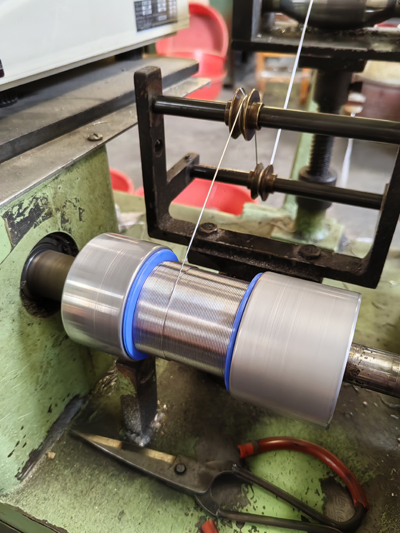
Our production process begins with the melting and alloying of virgin tin and lead ingots, followed by casting into round bars, extrusion, and multi-stage wire drawing. At each stage, quality control sampling verifies the alloy composition to ensure the tin-lead ratio remains within specification. The rosin core is injected during the drawing process, and the finished wire is spooled and labeled according to the customer‘s order requirements.
For importers concerned about consistency across shipments, this controlled process means that the Soldering Lead Sn40 Pb60 you receive in your second order will perform identically to the first. In a market where technicians are loyal to specific brands because they trust the behavior of the wire, this consistency is a commercial asset.
Foshan sits within the Pearl River Delta, one of the world’s most active export manufacturing regions. Shipments can be consolidated at Guangzhou or Shenzhen ports, with direct sailings to Durban and Cape Town. For smaller trial orders, air freight and express courier options are available. XF Solder routinely handles export documentation and packaging suitable for sea transport, including moisture protection and palletization.
The South African tin-lead solder market continues to show demand across industrial electronics, PCB assembly, and repair segments. While lead-free solders are mandated in certain regulated applications, the installed base of legacy equipment and the prevalence of repair-oriented workshops mean that Soldering Lead 40 60 remains a commercially viable product line.
By sourcing directly from a Soldering Lead Chinese Factory rather than through intermediary traders, South African importers capture better margins and can build a private-label or exclusive distribution arrangement. XF Solder offers flexible labeling and packaging options for customers who wish to establish their own brand identity in the local market.

The Soldering Lead Sn40 Pb60 alloy melts over a range from approximately 183°C to 238°C. Because it is not a eutectic alloy, it passes through a semi-solid phase before fully liquifying. For hand soldering, technicians typically set their soldering iron between 350°C and 400°C, depending on the thermal mass of the joint and the diameter of the wire. The larger 3.2mm wire may require a higher tip temperature or a more powerful iron to feed adequately without the tip temperature collapsing. For the 0.9mm diameter on typical through-hole work, 350°C to 370°C is usually sufficient. It is worth noting to end-users that leaded solder requires lower iron temperatures than lead-free alternatives, which contributes to reduced tip oxidation and longer equipment life.
The Soldering Lead with Rosin Sn40 Pb60 is suitable for the vast majority of general electronics repair and assembly tasks, particularly where the boards are not subject to RoHS compliance requirements. Rosin flux is non-corrosive and its residue is generally safe to leave on the board. However, there are two important limitations to communicate to your customers. First, this alloy contains lead and is not RoHS compliant; it should not be used on products intended for export to regulated markets that require lead-free construction. Second, while rosin is effective for clean, freshly exposed surfaces, heavily oxidized or contaminated boards may require additional flux application beyond what the core provides. For South African repair technicians working primarily on legacy consumer electronics and industrial equipment, these limitations rarely pose practical problems.
Yes. XF Solder accommodates mixed-diameter orders within a single shipment, allowing South African distributors to stock 0.9mm, 1.5mm, and 3.2mm in proportions that match their local demand patterns. The Soldering Lead Sn40 Pb60 250g spool format is standard, and we can arrange carton configurations that combine diameters or keep them separate for warehouse picking efficiency. As a Soldering Lead Chinese Factory, our minimum order quantities are structured to support both first-time trial orders and recurring container shipments. We recommend that new importers begin with a modest mixed order to validate market response before committing to larger volumes. Our export team can provide a quote based on your specific diameter mix and packaging preferences.
Storage conditions matter significantly for maintaining the performance of Soldering Lead Sn40 Pb60 for Electronics. While the alloy itself does not degrade under normal conditions, the rosin core can absorb moisture over time, and the surface of the wire can oxidize if exposed to humid air. South Africa‘s coastal regions, particularly Durban and Cape Town, experience higher humidity levels that warrant reasonable precautions. Spools should be kept in their original packaging in a dry, cool location away from direct sunlight. If a spool is partially used, resealing it in a plastic bag or container is advisable. For distributors holding stock for extended periods, a first-in-first-out rotation system ensures that older stock moves first. Under proper storage conditions, the solder wire maintains its soldering characteristics for well over a year, though the freshest stock always provides the most consistent flux activity.
The Soldering Lead with Rosin Core Sn40 Pb60 40 60 in 250g spools, available in 0.9mm, 1.5mm, and 3.2mm diameters, represents a practical and commercially sound addition to any South African electronics or hardware distributor’s catalogue. The alloy‘s forgiving working characteristics, the convenience of the rosin core, and the distribution-friendly spool size align well with the needs of repair technicians, electricians, and general electronics assemblers.
XF Solder operates as a dedicated Soldering Lead Chinese Factory with direct control over alloying, drawing, fluxing, and packaging. For South African importers seeking a reliable supply partner for this classic alloy, we welcome inquiries regarding pricing, sample requests, and packaging customization. Our export team is prepared to assist with logistics planning from Foshan to your warehouse in South Africa, ensuring that your first shipment arrives with the documentation and quality consistency your business requires.
Contact XF Solder today to discuss your requirements for Soldering Lead Sn40 Pb60 and secure a supply chain that supports your growth in the South African electronics marketplace.
Contact us:
Email: xfsolder@163.com or xfsolder@gmail.com
WhatsApp/Wechat: +8613450770997


 注: 建议图片大小150px*50px