|


| Quantity: | |
|---|---|
Description: XF Solder is a professional Tin Coil Chinese Manufacturer supplying Tin Coil Sn40 Pb60 with flux core in 225g and 450g spools, 0.8mm and 1.2mm diameters, engineered for circuit board assembly factories in Uruguay. Request bulk pricing today.
For circuit board assembly plants in Uruguay, consistent solder performance is not a minor detail—it directly affects first-pass yield, rework rates, and delivery schedules. When you are running mixed production lines that include both fine-pitch through-hole work and larger solder joints, having a solder wire that behaves predictably at the bench matters more than chasing the lowest per-gram price.
XF Solder has built its reputation as a Tin Coil Chinese Manufacturer by focusing on exactly this balance: stable alloy chemistry, consistent flux core distribution, and packaging formats that match the daily consumption patterns of electronics factories. The Tin Coil Sn40 Pb60 we supply to Uruguayan assembly operations is produced with tightly controlled tin and lead ratios, then wound onto 225g and 450g spools in 0.8mm and 1.2mm diameters. This article explains why this specification works for circuit board factories, how to choose between the two diameters and spool sizes, and what to verify before placing a bulk order from China.
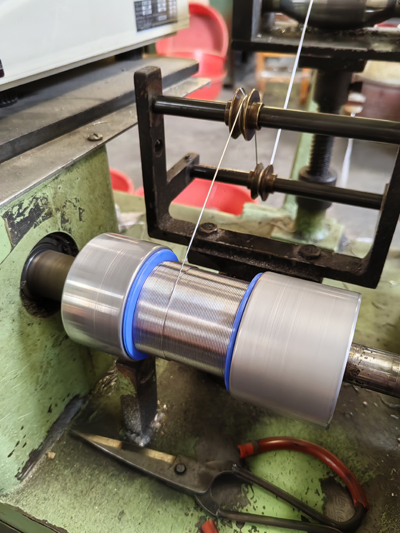
The designation Tin Coil 40 60 refers to an alloy of approximately 40% tin and 60% lead. This is a traditional leaded solder composition with a melting range that begins around 183°C and completes near 235°C depending on the exact ratio and heating rate . Compared with near-eutectic Sn63/Pb37, the higher lead content in Tin Coil 40 60 produces a slightly wider plastic range during solidification. In practical terms for a circuit board factory, this means the alloy tolerates minor variations in iron temperature and operator dwell time without sudden slumping or bridging on densely populated boards.
For Uruguayan factories that assemble a mix of consumer electronics, power supplies, and industrial control boards, this forgiving behavior reduces the learning curve for new operators and stabilizes results across shifts. The alloy also wets reliably to standard HASL and ENIG finishes when paired with an activated rosin flux core.
A solder wire is only as good as the flux inside it. Tin Coil with Flux Core Sn40 Pb60 from XF Solder uses a rosin-based flux core that activates at soldering temperature to remove light oxidation from pads and component leads, then leaves a residue that is non-conductive and generally safe to leave on most industrial boards. The flux core is distributed continuously along the wire’s length, so the flux-to-alloy ratio remains consistent from the first meter of the spool to the last. Factories that have experienced flux-starved sections in lower-cost wire understand why this consistency is worth specifying.
The Tin Coil Sn40 Pb60 0.8mm diameter is the workhorse for through-hole components with lead spacing of 2.54mm or tighter, as well as for touch-up and rework on surface-mount pads. At 0.8mm, the wire feeds smoothly into small joints without depositing excess solder, which is critical when working near fine-pitch ICs or closely spaced connector pins. Operators can control the deposit with short, deliberate strokes rather than dragging a thick wire across the board.
For Uruguayan factories running mixed-model lines, the 0.8mm spool is often the most frequently replaced item at the bench. Keeping Tin Coil Sn40 Pb60 0.8mm in the 225g format near the workstation reduces handling interruptions without forcing operators to manage a heavy spool.
The Tin Coil Sn40 Pb60 1.2mm diameter serves a different purpose. Larger joints—ground pads, connector shells, power component leads, and board-level shielding—require more solder volume per joint. A 1.2mm wire delivers that volume with fewer passes, shortening cycle times on assemblies that would otherwise bottleneck at the soldering station. The thicker wire also resists kinking and tangling when fed from a spool at an angle, which is a practical advantage in busy work cells.
Factories often stock both diameters and assign them by joint type rather than by operator preference. This simple discipline prevents the most common soldering defect in mixed assembly: too much solder on fine joints because the wrong wire was within arm’s reach.
The Tin Coil Sn40 Pb60 225g spool is designed for workstation-level use. It mounts easily on standard solder feeders and wire stands, and its weight is light enough that operators can swap spools quickly when changing wire diameters or when a spool runs out mid-batch. For factories that perform frequent changeovers between product models, the 225g format reduces the cost of partial spools left on the shelf when a job ends.
The Tin Coil Sn40 Pb60 450g spool suits higher-consumption lines where the same wire diameter runs for extended periods. A 450g spool lasts roughly twice as long as a 225g spool under identical consumption, cutting the number of spool changes per shift. For a circuit board factory in Uruguay running steady production on a limited number of models, the 450g format reduces line-side handling and the associated risk of wire contamination during spool swaps.
Both spool sizes are wound on sturdy plastic cores that resist deformation during international shipping from China to Uruguay. XF Solder can also discuss customized labeling and packaging requirements for factories that need traceability information on each spool.

When evaluating Tin Coil with Flux Core 40 60 from any supplier, three checks separate reliable product from commodity-grade wire. First, verify the alloy composition through a mill certificate or third-party assay. Small deviations in tin content shift the melting behavior and wetting speed. Second, inspect the flux core continuity by cutting several sections along a spool and confirming the core is centered and uninterrupted. Third, check the wire surface for oxidation or drawing lubricant residue, which can cause spattering and poor wetting even with an active flux.
XF Solder performs these checks on every production lot and can provide documentation with shipments to Uruguay. For factories operating under quality management systems that require incoming inspection records, this documentation reduces the burden on internal QC teams.
Uruguay’s electronics manufacturing sector operates in a climate that ranges from humid coastal conditions in Montevideo to drier inland environments. Humidity matters for solder wire storage. Even a well-formulated Tin Coil Sn40 Pb60 for Circuit Board application can underperform if spools are stored in uncontrolled areas where the wire surface oxidizes between uses. We recommend keeping spools in sealed bags with desiccant until loading, and returning partial spools to sealed storage at the end of each shift.
The flux core in XF Solder’s wire is formulated to activate across a reasonable temperature window, which helps when iron temperatures vary between operators or stations. For factories using leaded processes, this alloy remains a practical choice for general-purpose assembly where RoHS exemptions apply or where the product is destined for markets that still accept leaded solder.
Sourcing from a Tin Coil Chinese Manufacturer offers clear cost advantages, but only when the supplier understands export logistics and quality consistency. XF Solder has supplied solder wire to distributors and assembly plants across South America, and we structure our production and documentation around the realities of international procurement. That means clear alloy certificates, consistent spool weights, and packaging that survives ocean freight without crushed cores or abraded wire.
Our position as a Tin Coil Chinese Manufacturer also means we control the drawing and fluxing processes in-house rather than buying finished wire from third parties. This vertical control is what allows us to maintain diameter tolerances and flux ratios across production runs, and to respond quickly when a customer needs a specific spool size or diameter combination.

Q1: What is the difference between Tin Coil Sn40 Pb60 and Sn63/Pb37?
The main difference is the tin-to-lead ratio. Tin Coil Sn40 Pb60 contains roughly 40% tin and 60% lead, giving it a wider melting range and a more forgiving behavior on uneven heating. Sn63/Pb37 is near-eutectic and solidifies more abruptly. For general circuit board assembly where iron temperature control is moderate, the 40/60 alloy offers a practical balance of cost and performance.
Q2: Can I order mixed spool sizes and diameters in one shipment?
Yes. XF Solder supports mixed containers that combine Tin Coil Sn40 Pb60 225g and Tin Coil Sn40 Pb60 450g spools, as well as both 0.8mm and 1.2mm diameters. Mixed orders help Uruguayan factories trial different configurations before committing to a full container of a single specification.
Q3: What flux type is inside the Tin Coil with Flux Core Sn40 Pb60?
The standard core is a rosin-based flux with moderate activity, suitable for general electronics soldering. If your factory requires a specific flux classification or halide content for compliance reasons, communicate this before ordering so the formulation can be confirmed against your requirements.
Q4: How should we store the wire in Uruguay’s climate?
Store spools sealed with desiccant in a cool, dry area away from direct sunlight. Once a spool is opened, reseal it or keep it in a covered feeder between shifts. Humidity control is more important than temperature control for preventing surface oxidation on Tin Coil Sn40 Pb60 wire.
Q5: What is the lead time from order to delivery in Montevideo?
Typical production lead time is 3–4 weeks after order confirmation, with ocean freight from China to Montevideo adding approximately 35–45 days depending on routing and vessel schedules. XF Solder provides shipment updates and documentation support throughout the process. For urgent trial quantities, ask about air freight options for partial spools.
The Tin Coil Sn40 Pb60 specification—whether in 225g or 450g spools, 0.8mm or 1.2mm diameter—is not the most advanced solder alloy on the market. It is, however, one of the most practical for circuit board factories that need predictable wetting, forgiving process windows, and reasonable cost per joint. When sourced from a Tin Coil Chinese Manufacturer that controls its drawing and fluxing processes, this traditional alloy remains a dependable workhorse for Uruguayan assembly lines.
XF Solder invites Uruguayan circuit board factories to request samples, current pricing, and alloy certificates for evaluation. Tell us your monthly consumption, preferred spool size, and diameter mix, and we will propose a supply schedule that keeps your benches stocked without tying up capital in excess inventory.
Contact us:
Email: xfsolder@163.com or xfsolder@gmail.com
WhatsApp/Wechat: +8613450770997


 注: 建议图片大小150px*50px