|


| Quantity: | |
|---|---|
When a soldering job demands predictable flow, instant solidification, and joints that hold up under thermal cycling, the alloy choice often narrows to one classic formulation. Roll solder 63 37—the eutectic tin-lead blend—has remained the benchmark for hand soldering and rework across electronics workshops for decades, not out of nostalgia, but because its metallurgy solves specific problems that lead-free alternatives still struggle to match.
XF Solder manufactures this alloy as a factory-direct product in China, supplying roll solder Sn63 Pb37 in three practical diameters and three spool weights tailored to the rhythms of both production lines and repair benches. This page explains what the alloy does, how to select the right diameter and spool size, and why workshops that know their requirements keep returning to eutectic tin-lead.
The numbers 63 and 37 refer to the percentage of tin and lead by weight. What matters technically is that this ratio sits almost exactly at the eutectic point of the tin-lead system. In practical terms, roll solder 63 37 melts at a single temperature—183°C—and freezes at that same temperature, with no plastic or pasty phase in between.
This single-point phase transition is the reason technicians prefer it. When a joint cools, it goes from liquid to solid instantly. A hand tremor or a cable shift during cooling cannot disturb the joint because there is no semi-solid window in which movement causes the grainy, unreliable structure known as a cold joint. Alloys like Sn60/Pb40 pass through a brief slushy range during solidification, and that is precisely where disturbed joints form.
The eutectic behavior also makes roll solder Sn63 Pb37 forgiving at the iron. It wets oxidized pads readily, flows into through-hole barrels without excessive dwell time, and produces the shiny, well-formed fillets that make visual inspection straightforward. For repair work—where the board in front of you may be old, heat-damaged, or carrying components you cannot afford to cook—that low operating temperature and quick wetting translate directly into lower risk.
The 0.8mm diameter occupies a useful middle ground. It is thin enough to feed controlled amounts into small through-hole pads and larger surface-mount joints, yet substantial enough that you are not standing there feeding wire endlessly into a ground plane.
For repair technicians, roll solder 63 37 0.8mm covers the majority of everyday jobs: replacing electrolytic capacitors, reflowing cracked joints on connectors, touching up header pins, and general PCB rework where the pad size is neither microscopic nor massive. The wire feeds smoothly without the buckling that very thin gauges sometimes exhibit, and the 0.8mm size keeps solder volume predictable when you are working near sensitive adjacent pads.
Production environments that hand-solder through-hole components also benefit from this diameter. Operators can establish a consistent feed rhythm, and the eutectic alloy’s quick freeze means boards can be handled sooner after soldering without the risk of joint disturbance.

When the joint is large—a chassis ground lug, a heavy connector pin, a wire-to-terminal splice, or a power supply through-hole—thin wire becomes a liability. Feeding 0.8mm wire into a thermal mass that sinks heat away faster than the iron can deliver it produces exactly the conditions for a cold joint: prolonged iron contact, flux burnout, and incomplete wetting.
Roll solder 63 37 1.6mm delivers thermal mass and alloy volume quickly. The larger diameter carries more flux per unit length as well, which helps on oxidized or heavily tinned surfaces where extra cleaning action is welcome. In appliance repair, power electronics, and industrial control panel work, this diameter is often the practical choice for the joints that actually carry current and mechanical stress.
XF Solder draws this wire with consistent flux core distribution, so the flux releases evenly rather than in surges. That consistency matters when an operator is working on a ladder or inside a cabinet where rework access is difficult and the first attempt needs to succeed.
At the upper end of the practical range, roll solder 63 37 3.0mm serves applications where the joint geometry demands substantial filler metal deposition. Battery cable lugs, large terminal blocks, grounding straps, and heavy gauge wire splices fall into this category. The wire is stiff enough to be directed precisely into a joint cavity, and it melts into a pool that penetrates stranded conductors effectively.
This diameter is not intended for PCB work. Using it on a circuit board would dump far too much solder far too quickly, bridging pads and flooding vias. Its place is in the chassis, the cabinet, and the cable harness—the places where electronics meet the physical world and the joint must survive vibration, thermal expansion, and the occasional tug.
Spool weight is a workflow decision as much as an economic one. A roll solder 63 37 200grams spool sits comfortably on a small bench stand, fits in a tool case, and represents a modest commitment for a technician who needs one diameter on hand without tying up capital in a kilogram that may sit unused for months.
For field service engineers and small repair shops, the 200-gram format is practical. It is enough wire for dozens of typical repair jobs—hundreds of small joints—yet light enough that the spool does not fight the wire feed mechanism or take up drawer space. XF Solder winds these spools evenly to prevent tangling, a small detail that becomes noticeable when you are working in an awkward position and cannot afford the wire to snag.
The roll solder 63 37 500grams spool hits the middle of the usage curve. A workshop running several benches, or a single technician doing steady production soldering, will consume this amount within a reasonable timeframe without reordering constantly. The spool fits standard solder dispensers and stands, and the weight is manageable when moving between stations.
For contract manufacturers and OEM production lines that hand-solder assemblies, the 500-gram format balances spool-change frequency against inventory carrying cost. It is also a common choice for training environments where multiple students or trainees draw from a shared station—large enough to last through a class cycle, small enough that a dropped spool does not become a minor disaster.
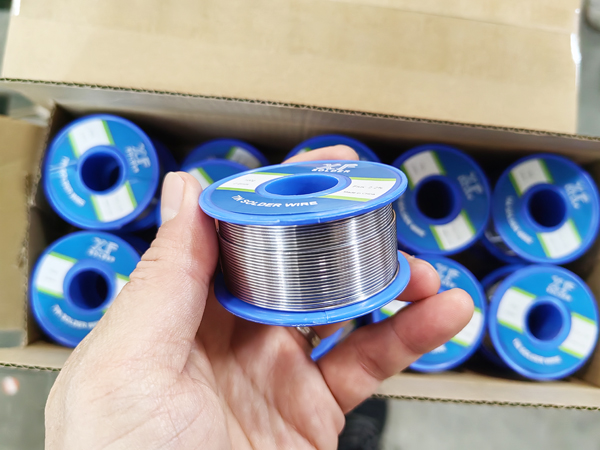
At the top of the range, roll solder 63 37 1kilogram spools serve production environments where soldering is continuous and interruptions are expensive. A 1kg spool on a bench stand means fewer changeovers, less packaging waste, and better per-gram economics when purchased in quantity from the factory.
XF Solder supplies these spools with consistent alloy composition verified against the Sn63/Pb37 specification: tin 63% and lead 37%, with impurity levels controlled to maintain the eutectic behavior that makes the alloy worth specifying in the first place. For factories that have qualified a soldering process around Sn63/Pb37, receiving wire that actually matches the certificate matters—small deviations in alloy ratio can shift the melting behavior and disrupt a validated profile.
Roll solder 63 37 for electronics is the correct choice in several contexts. Repair and rework of equipment already manufactured with leaded solder is the clearest case: matching the existing alloy avoids the mixing of incompatible metallurgies and the unreliable joints that can result. Prototyping and educational settings also benefit from the alloy’s forgiving nature, low melting point, and easy rework characteristics.
It is also used in RoHS-exempt applications—military, aerospace, and某些 medical equipment—where the performance advantages of eutectic tin-lead are recognized and permitted under regulatory carve-outs. And in settings where RoHS compliance is not legally required for the product being built or repaired, the technician’s choice between leaded and lead-free becomes a matter of process preference and component compatibility rather than regulatory obligation.
What roll solder 63 37 for electronics is not suited for is commercial manufacturing of products destined for regulated markets. If the finished product must carry a RoHS declaration, leaded solder has no place in its construction. XF Solder supplies both leaded and lead-free formulations, and we are direct about which applications each serves. A factory that needs SAC305 for export production should buy SAC305; a repair shop matching leaded joints on legacy equipment should buy the eutectic alloy. Mixing the two without understanding the distinction is how process problems start.

Because 63/37 is the eutectic composition. It transitions from liquid to solid at exactly 183°C with no intermediate pasty stage. Sn60/Pb40 has a small plastic range during cooling, and any movement in that window can create a disturbed, unreliable joint. The 63/37 alloy eliminates that risk entirely.
Yes, for larger SMD components and moderate pitch. The 0.8mm diameter is versatile enough for many SMT joints, though very fine-pitch work with 0402 or smaller components may call for a thinner wire like 0.5mm. For general SMT repair and larger passive components, 0.8mm feeds well and gives adequate control.
Under proper storage conditions—cool, dry, and away from corrosive atmospheres—the wire remains usable for an extended period. Flux core activity can degrade over time, particularly if the spool is exposed to humidity. We recommend using stock within two years of manufacture for critical work and storing spools sealed until the moment of use.
XF Solder offers flux core options to match your process. The standard rosin flux is suitable for most general electronics work with proper ventilation. No-clean formulations are available on request for applications where residue removal is impractical. Contact us with your flux classification requirement and we will confirm availability for the 1kg spool format.
Match the spool to your consumption rate. A single repair technician working part-time may take months to finish a 200g spool, which is fine—the wire does not expire overnight. A busy shop with two or three benches will find 500g spools reduce changeover interruptions. A factory running continuous production should specify 1kg spools or larger to minimize handling and packaging waste per gram of solder consumed.
Yes. We understand that wire handling, flux core consistency, and spool winding quality are things a buyer needs to verify before placing a production order. XF Solder provides sample spools in requested diameters and weights so your technicians can evaluate the product under actual working conditions. Contact us with your diameter and weight requirements to arrange samples.
XF Solder is a Chinese manufacturer, not a trading intermediary. That distinction shows up in three places: price, specification control, and communication. Factory-direct pricing removes the margin layers that accumulate when solder passes through importers and distributors. Specification control means the alloy you receive matches the composition on the label, because we melt and draw it ourselves. And communication is direct—when you need to confirm flux percentage, spool winding direction, or packaging for export, you speak with the people who make the product.
We supply roll solder 63 37 to electronics manufacturers, repair chains, educational institutions, and distributors across multiple markets. Whether you need 200-gram spools of 0.8mm for a repair kit or 1-kilogram spools of 1.6mm for a production line, the alloy is the same eutectic Sn63/Pb37 formulation, drawn to consistent diameter and wound to feed without tangling.
Contact XF Solder with your diameter, spool weight, and flux requirements. We will confirm pricing, lead time, and sample availability. For workshops that know what eutectic tin-lead does for their joints, the conversation starts with the specification—and that is exactly where it should start.
Contact us:
Email: xfsolder@163.com or xfsolder@gmail.com
WhatsApp/Wechat: +8613450770997


 注: 建议图片大小150px*50px